
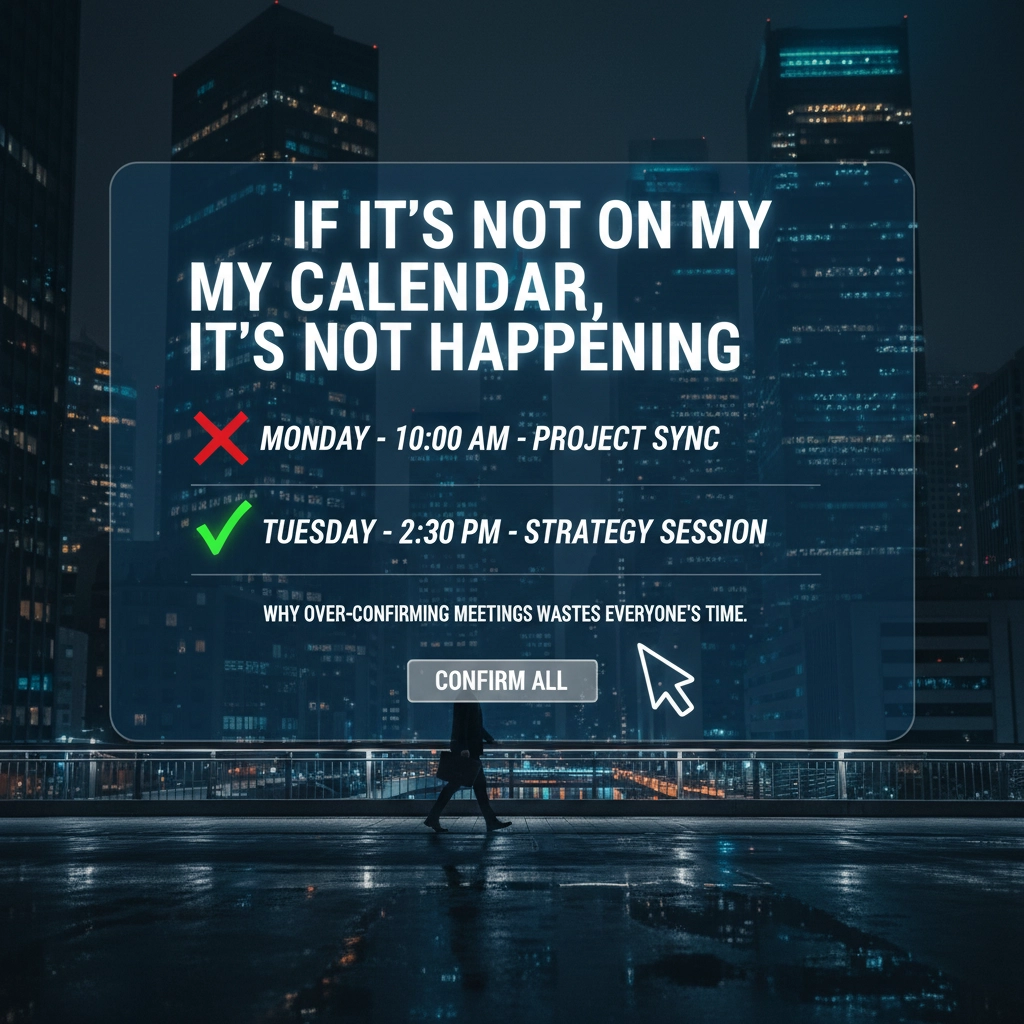
Look, I’m gonna be straight with you. I live and breathe by my calendar. If it’s not scheduled, it’s not happening. Period.
And if there’s one thing that really frustrates me, it’s people who send meeting invites, get an acceptance, then still feel the need to “confirm” that we’re still good for the meeting.
If I sent you an invite or said I’m going, I’m showing up.
Let me tell you about this one time that perfectly illustrates why this over-confirmation nonsense is killing productivity and professionalism in business.
The Real Estate Agent Who Taught Me a $300 Lesson
I had scheduled lunch with a real estate agent about a week in advance. Standard stuff, calendar invite sent, accepted, restaurant picked, time locked in.
When the day came, I showed up at the restaurant right on time, grabbed a table in the back, and waited. Five minutes pass. Ten minutes. Fifteen.
So I shoot them a text: “Hey, I’m in the back.”
Their response? “I didn’t know you were actually going to come because you never verified with me that you were going.”
I’m sitting there with my jaw on the floor. Unprofessional doesn’t even begin to cover it.

This person had my calendar invite acceptance. They knew I was coming. But because I didn’t engage in the extra “confirmation” step, they assumed I was a no-show and didn’t bother showing up themselves.
That’s when it hit me: We’ve created a culture where accepted calendar invites apparently mean nothing unless you jump through additional hoops to “prove” you’re serious.
The Confirmation Trap That’s Crushing Entrepreneurs
Here’s what’s happening in the business world, and it’s costing us all money:
Traditional industries (real estate, insurance, some service businesses) have trained people to expect multiple confirmations. They send reminder calls, confirmation emails, “just checking” texts: the whole nine yards.
But high-performing entrepreneurs, coaches, and experts operate differently. We move fast. We make decisions. When we accept a meeting, we show up. Our word is our bond, and our calendar is our contract.
The problem? These two worlds are colliding, and it’s creating massive inefficiencies.
Think about it: If you’re spending time sending confirmation messages, fielding “are we still good?” calls, and managing the anxiety around who’s actually going to show up, that’s mental bandwidth you’re not using to make money.

The Real Cost of Over-Confirmation Culture
Let’s do some quick math on what this nonsense actually costs:
Time Investment:
- Original meeting setup: 5 minutes
- Confirmation email/call: 3 minutes
- Response management: 2 minutes
- Total per meeting: 10 minutes of extra overhead
If you’re doing 20 meetings per month (which is conservative for most entrepreneurs), that’s 200 minutes: over 3 hours: wasted on confirmation theater.
At a $200/hour billing rate, you just threw away $600+ per month on activities that add zero value to your business.
But the real cost isn’t just time: it’s the trust breakdown.
When you over-confirm, you’re essentially saying: “I don’t trust that your calendar acceptance means anything.” You’re training people that their word doesn’t matter until they’ve said it three times.
How High-Performance People Actually Handle Meetings
Here’s how the most successful entrepreneurs, coaches, and experts I know handle meeting confirmations:
1. One Invite, One Response, Done Send the calendar invite. If they accept, it’s locked. No follow-up needed.
2. Clear Expectations Up Front “I operate by calendar invites. If it’s on the calendar and accepted, I’ll be there. I expect the same from you.”
3. The 10-Minute Rule Show up on time. If the other person isn’t there within 10 minutes, leave. Your time is valuable.
4. Professional Consequences If someone no-shows because they “expected confirmation,” that’s a red flag about how they operate. Adjust your business relationship accordingly.

Setting the Right Frame From Day One
Want to eliminate confirmation chaos? Here’s the exact framework I use:
For New Business Relationships: “Just so you know how I operate: When I send a calendar invite and you accept it, that’s our commitment. I’ll be there, and I expect you to be there. No additional confirmation needed unless there’s an emergency.”
For Existing Clients/Partners: “I’m streamlining my meeting process. From now on, accepted calendar invites are firm commitments. This helps both of us stay focused on what matters most.”
For Your Team: “We’re moving to a calendar-only meeting system. Accepted invites = guaranteed attendance. This eliminates the back-and-forth and keeps us all productive.”
Why This Matters for Your Income
Here’s what most people miss: Professional meeting culture directly impacts your income potential.
When you operate with clear systems and boundaries around time, several things happen:
- You attract higher-quality clients who also value efficiency
- You eliminate time-wasters who don’t respect professional boundaries
- You increase your actual productive hours by cutting confirmation overhead
- You position yourself as someone who gets things done
The real estate agent who stood me up? They lost a potential client who values efficiency and professionalism. Their over-confirmation culture cost them money.

The Miami Marketer Standard
At Miami Marketer, we’ve built our entire client interaction system around this principle. When you book a discovery call with us, here’s what happens:
- Calendar invite sent with clear agenda
- Confirmation email with everything you need
- No follow-up calls asking if you’re “still good”
Why? Because we work with serious entrepreneurs who understand that accepted calendar invites are commitments.
If someone can’t handle that level of professionalism, they’re probably not ready for the kind of growth strategies we implement anyway.
Your Action Plan
Starting tomorrow, implement the “Calendar Contract” system:
Week 1: Set expectations with all new meeting requests
Week 2: Communicate the new system to existing business relationships
Week 3: Stop sending confirmation messages entirely
Week 4: Track the time you’re saving and redirect it to income-producing activities
The Bottom Line
Your calendar is your contract. Your acceptance is your signature.
If more business people operated this way, we’d all be making more money and wasting less time on administrative theater.
Stop confirming what’s already confirmed. Start treating your time like the valuable asset it is.
And if you’re ready to work with a team that respects your time and operates with the efficiency your business deserves, let’s talk. No confirmation calls required.